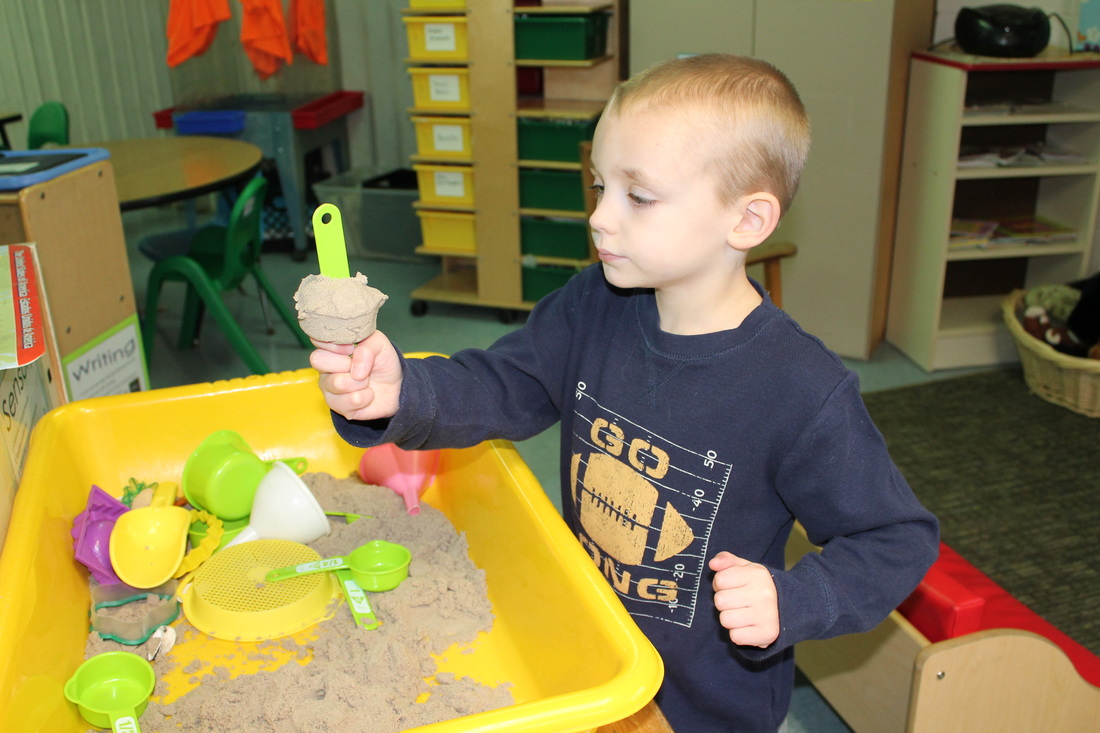
 Many parents are very interested in their children learning to write their names in preschool. This is a skill that children will need in kindergarten; however, many preschool students may not be ready yet. Preschoolers need to have muscle control in their hands and throughout their bodies in order to correctly hold a pencil and print letters. Child development principles tell us that children develop from the center of the body out towards extremities. This means that children must first develop control of their core muscles and their upper body before they will have control of their hand muscles. When a child is struggling with handwriting, many occupational therapists will recommend activities like swimming and climbing before sitting a child down with paper and pencil.
If children are strongly encouraged to practice printing before they are developmentally ready, it can cause strain to the muscles in their hands. Some children may even feel stress when the teacher invites them to participate in activities that they find to be too challenging. Preschool should be a time when teachers can help cultivate a love of learning in their students, but this love of learning can not develop if children are afraid to participate in classroom activities. A developmentally-appropriate preschool classroom focuses on allowing children to explore the classroom materials instead of asking children to sit at tables and complete teacher-directed activities. To prepare children for handwriting activities in elementary school, preschool teachers need to allow children to participate in activities where they explore the alphabet letters and improve their fine motor skills. Appropriate fine motor activities include: peg boards, play dough, modeling clay, lacing boards, puzzles, nuts and bolts, shape sorters, stringing beads on pipe cleaners, basic sewing activities, using tongs or tweezers, sorting, using small blocks or Legos, or ripping paper. In fact, play dough and modeling clay are two of the best activities that children can use at home to develop hand strength and prepare for handwriting activities. Children in preschool can begin creating letters by: writing letters in shaping cream, making letters with wood pieces, exploring alphabet puzzles, tracing on sandpaper letters, finding alphabet beads in play dough or in a sensory table, using magnetic letters on a cookie sheet, felt letters on a flannel board, drawing letters on a Magnadoodle, creating letters with play dough, labeling all materials throughout the classroom, and displaying environmental print familiar to young children. These activities can help children learn what letters look like while developing their hand strength. They also support a free-choice classroom that is led by the interests of the children and establish independence by allowing children to select their own materials and learn at their own pace.
0 Comments
Leave a Reply. |
AuthorDr. Sarah Vanover has been working in the field of early childhood education for over 22 years and has had the opportunity to be a teacher, a director, and a trainer for other early childhood educators. She has a passion for making sure that children with special needs receive high-quality early care and education. Archives
September 2017
Categories |
 RSS Feed