Sarah Vanover
  • Home
  • Books
  • Workshops
  • Blog
  • About Author
  • Contact

Blog

What Does Preschool Math Look Like?

7/3/2017

0 Comments

 
Picture
         Young children learn about math and science each day during typical conversations.  They see shapes in their natural environment like the stop signs on the street.  They decide if they want more or less.  These normal conversations introduce new vocabulary and concepts before children enter kindergarten.  With an increased emphasis on STEM skills (science, technology, engineering, and mathematics) in elementary and secondary education, the caregivers of preschoolers are extremely interested on how math and science concepts can be implemented in the preschool classroom.  Early childhood mathematics should not look like children memorizing numbers or answering simple equations; however, there are key pre-math skills that all children should learn to be ready for school.
 
  • Counting – Children do need to learn to count in order, which is called rote counting, but it is best learned during typical conversations.  Ask children to count how many blocks are in the tower or how many crackers they are eating at snack time.  It is also important for children to recognize the numeral symbols.  They should see numerals in their normal, daily environment like on the calendar, the page numbers in a book, or magnetic numbers on the refrigerator door.
  • Sorting and Classification – An essential mathematical skills for children is learning to group items by similar characteristics (color, shape, or other properties).  In the preschool classroom, this may look like sorting pom pom balls into cups by color or placing blocks by on the shelf according to their shapes.
  • Comparing – An important pre-math skill is for children to learn to compare items.  They usually start with comparisons like big/little and short/tall.  This is also when children begin to compare more and less.  This is a key math skill that they will use in the future for both simple and complex equations.  Children learn to compare in the classroom by using informal comparisons.  They may learn to measure with wooden blocks, and document that they are 4 or 5 blocks tall.  They also begin to notice comparisons like “She got more snack than I did.”
  • Ordering – Learning about ordering is frequently called seriation.  Children learn to organize objects by big to little, heavy to light, cold to hot, and short to long.  Sequencing helps children to learn the order of events and cause and effect.  This is a higher form of comparison since children must distinguish many levels of comparison.
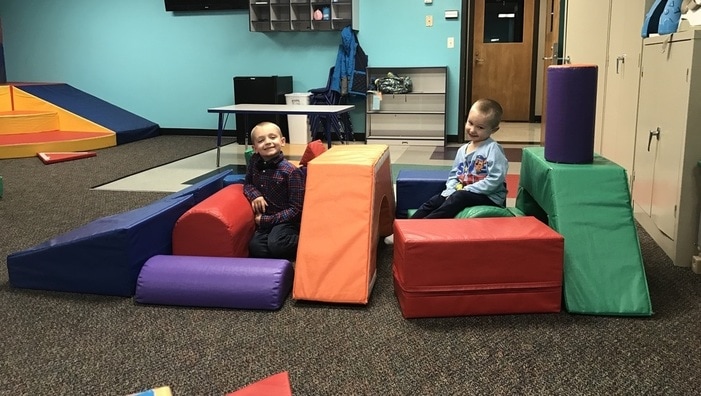
  • Shape and Form – Pre-mathematics includes learning shapes and directions (ex. under, over, beside).  These skills are frequently learned in the block area when children have to learn spacial relations to create the tower that they desire.  Learning these early shape patterns not only increases vocabulary but establishes a foundation of geometry skills in higher grade levels.
 
     Children learn mathematical skills in the classroom by play and exploration.  This means that one of the most important jobs of the early childhood educator is to make sure that there are a variety of math materials for the children to use during play time.  Children also learn math concepts through conversation and song.  Teachers need to dedicate time each day to having conversations with the children while they play.  During play time, the educator can include simple math questions into the conversation like “How many bears are sitting on the block?”  Teachers can also use simple songs to include math concepts in daily conversations. 
0 Comments


Leave a Reply.

    Author

    Dr. Sarah Vanover has been working in the field of early childhood education for over 22 years and has had the opportunity to be a teacher, a director, and a trainer for other early childhood educators.  She has a passion for making sure that children with special needs receive high-quality early care and education.

    Archives

    September 2017
    August 2017
    July 2017
    June 2017
    January 2017
    December 2016
    November 2016
    October 2016
    September 2016
    August 2016

    Categories

    All

    RSS Feed

  • Home
  • Books
  • Workshops
  • Blog
  • About Author
  • Contact